
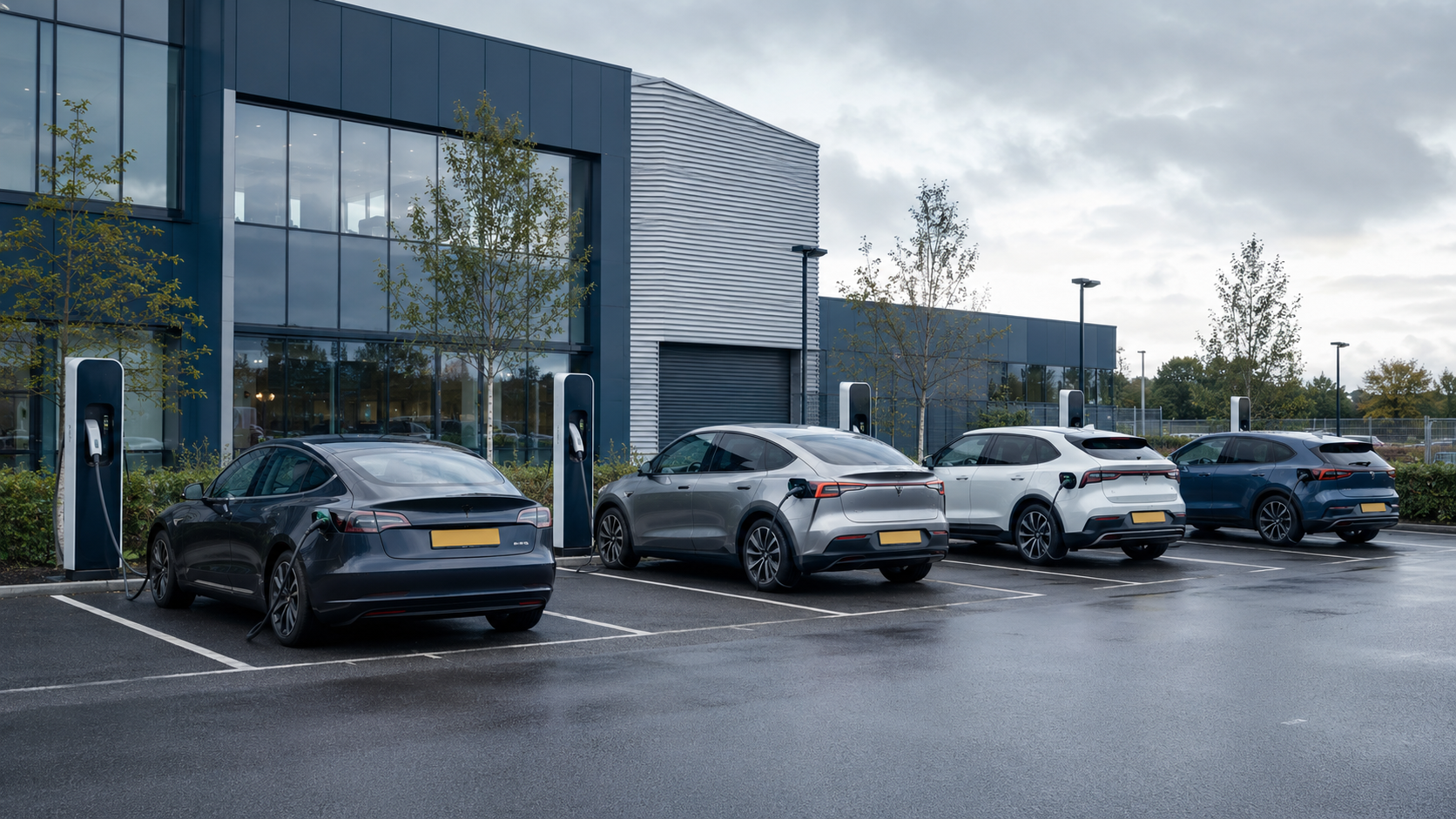
Commercial EV Charger Installation in Tunbridge Wells
Plan charging for employees, company vehicles, tenants or visitors with an independent installation company able to survey the site, assess electrical capacity and prepare a project-specific quotation.
- Single and multi-bay installations
- Electrical capacity and cable-route surveys
- Load management and phased expansion
- Workplace grant eligibility considered
Request a Commercial Quote
Tell us where the charging project is located. Your enquiry can be matched with an independent installer covering Tunbridge Wells.
Commercial charging planned around your operation
EV Charging for Workplaces, Fleets and Commercial Property
A commercial EV charging project should start with how the site operates, not with a charger catalogue. Vehicle dwell times, daily mileage, shift patterns, parking ownership, electrical capacity and future demand all affect the number, speed and control of the chargepoints.
Employee Charging
Provide controlled charging for staff vehicles with user access, fair-use policies and optional payment or reimbursement reporting.
Fleet and Depot Charging
Match available overnight or between-shift time to vehicle routes, battery sizes and operational departure deadlines.
Landlords and Managing Agents
Plan shared or allocated charging for offices, mixed-use property, residential blocks and managed commercial estates.
Visitors and Customers
Consider destination charging, public access, pricing, signage and payment obligations where bays will serve guests or customers.
A designed electrical infrastructure project
What a Commercial Installation Must Account For
Commercial charging combines electrical design, parking layout, network connectivity and daily operating rules. A useful quotation should define the complete system and the assumptions behind it.
Evidence before equipment selection
Commercial EV Charger Site Survey
The survey turns a general requirement into a buildable design. It should record the incoming supply, main protective device, metering, distribution equipment, earthing arrangement and existing demand. The installer may need interval data or measured load information rather than relying on a single meter photograph.
Outside, the survey should measure the route from the electrical intake to each proposed bay. It should identify walls, ducts, soft ground, drainage, buried services, vehicle routes, pedestrian paths, lighting columns and areas that may need trenching or surface reinstatement.
The installer should also confirm who owns or leases the parking, whether landlord or managing-agent consent is needed and whether planning, listed-building, lease or estate rules affect the work.

Speed is only useful when vehicles can use it
Choosing Charger Power and Quantity
The right design supplies enough energy before each vehicle leaves while avoiding unnecessary power, infrastructure and subscription costs.
| Charging approach | Usually considered for | Planning points |
|---|---|---|
| 7kW AC | Employee cars, pool vehicles, overnight fleet parking and longer visitor stays. | Often practical where vehicles remain parked for several hours; multiple units may share available capacity through load management. |
| 11kW AC | Compatible fleet cars and vans where three-phase power is available. | The vehicle must accept 11kW AC. Supply, distribution and charger configuration must support three-phase use. |
| 22kW AC | Shorter dwell times or vehicles with 22kW onboard AC charging. | Many vehicles accept less than 22kW AC, so faster hardware will not automatically produce faster sessions. |
| DC rapid charging | High-utilisation fleets, operational turnaround or public destination charging. | Needs a separate business case covering grid capacity, equipment, civils, maintenance, payment and expected utilisation. |
Power descriptions are maximum ratings, not guaranteed vehicle charging speeds. The vehicle, battery state, temperature, charger allocation and site limit all influence actual performance.

Operational charging rather than simple socket count
Fleet Charging and Duty-Cycle Planning
A fleet study should record vehicle battery size, expected daily energy use, arrival and departure times, parking consistency and any critical routes. A van returning at 6pm and leaving at 6am has a different charging requirement from a vehicle that turns around several times a day.
Not every vehicle necessarily needs the maximum charger output, and not every parking space needs equipment on day one. A phased design can install the right electrical backbone, ducts or distribution capacity now while adding chargepoints as vehicles arrive.
- Prioritise vehicles with the earliest departure
- Set charging limits around real route energy
- Allow for seasonal consumption and vehicle changes
- Define what happens after a missed or failed charge
- Plan access for maintenance without blocking operations
Using available capacity intelligently
Dynamic Load Management and Future Expansion
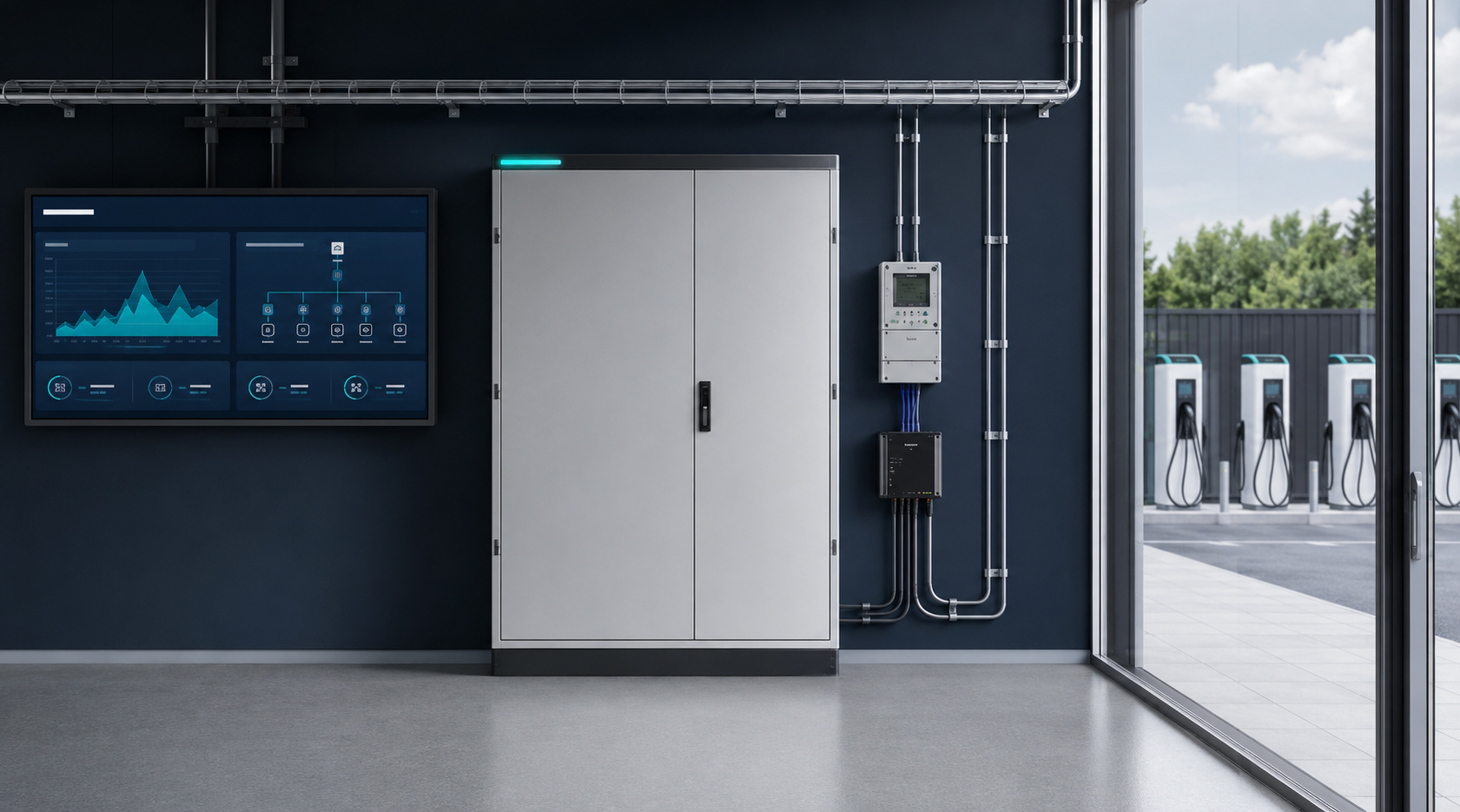
Load management can distribute a defined amount of power across several chargers and reduce charging when the rest of the building is using more electricity. This may allow a useful installation without immediately increasing the incoming supply, although it is not a substitute for proper electrical assessment.
The design should state where the site load is measured, what happens if the network connection fails, whether charging priorities can be set and whether the system is local, cloud-managed or both. For fleets, priority rules may need to consider departure time or required energy rather than sharing power equally.
If the survey shows that the existing supply cannot support the proposed operation, the installer may need to discuss the project with the Distribution Network Operator. Any supply alteration, new connection, transformer work or network reinforcement can affect cost and programme.
From intake position to every bay
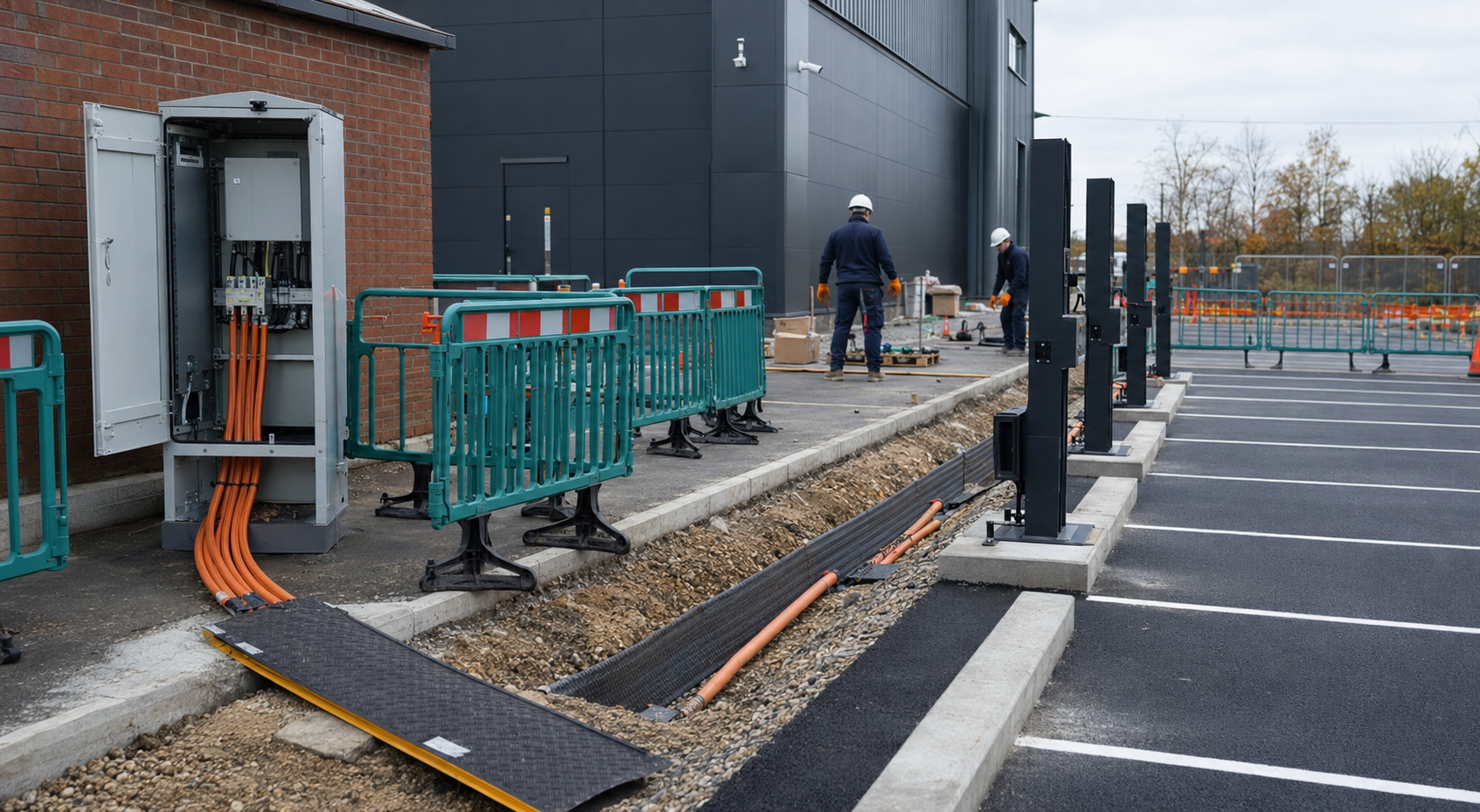
Cable Routes, Civils and Parking Protection
Commercial sites often require more than electrical cable. The project may include trenching, ducts, draw pits, wall or tray containment, concrete bases, posts, wheel stops, impact-protection bollards, bay markings and reinstatement of paving or asphalt.
The route should avoid creating trip hazards and should respect drainage, buried services, fire exits, loading movements and accessible pedestrian paths. Where chargers stand between vehicles, their reach and position should reduce the risk of cables crossing walkways or being trapped under tyres.
A clear quotation should identify who is responsible for scans, excavation, spoil removal, reinstatement, traffic management and making good. It should also state which work is provisional until services or ground conditions are confirmed.
Connected operation and accountable use
Access, Payments and Back-Office Control
Commercial chargers may need RFID cards, an app, automatic vehicle recognition, guest access or contactless payment. The right choice depends on who uses the bays and whether electricity is free, reimbursed or sold.
If chargepoints will be open to the public, the operator should check the Public Charge Point Regulations and any other duties that apply. Legal, tax and employment policies should be confirmed with appropriate advisers.
Funding subject to current rules
Workplace EV Charger Grants
The Workplace Charging Scheme can support eligible businesses, charities, public-sector organisations and small accommodation businesses. Under the rules checked in July 2026, it covers up to 75% of eligible purchase and installation costs, capped at £500 per socket and 40 sockets across all sites per applicant.
Funding is confirmed until 31 March 2027. A qualifying workplace needs dedicated off-road parking associated with the premises, the correct evidence and permission to install. For a business application, the parking must be for staff or fleet use rather than solely for customers.
The site should be surveyed before the grant application. A voucher must be issued and the current scheme process followed; the work must use an authorised installer and eligible equipment. Do not begin work on the assumption that a grant will be approved.
Read the EV Charger Grants GuideA practical route from enquiry to operation
How the Commercial EV Charger Installation Process Works
The exact programme depends on project size, site access, network work and permissions. The installer should identify dependencies before a start date is agreed.
Project Brief
Define users, vehicles, parking, daily energy, dwell times, number of bays and expected future growth.
Desktop Review
Share supply details, photos, plans and fleet information so obvious constraints can be identified.
Site Survey
Assess electrical capacity, distribution, cable routes, parking, connectivity, civils and permissions.
Design and Quote
Specify equipment, load control, back office, groundworks, protection, exclusions, price and programme.
Approvals and Build
Complete grant, landlord, DNO or planning steps where required, then install with agreed site controls.
Testing and Handover
Commission every socket, test user access, provide certification, demonstrate controls and agree support.

What should be included at handover
Commissioning, Certification and Ongoing Support
Handover should go beyond showing that a car can charge. The installation company should provide the electrical certification and relevant notifications, identify circuits and isolation points, record charger serial numbers and demonstrate the access and back-office system.
Ask for administrator ownership of the charging platform, user instructions, warranty information, support contacts and a schedule for inspection or maintenance. Confirm who responds when a charger is offline and whether remote support, call-out costs or software subscriptions are included.
- Electrical test results and installation certificate
- Commissioning record for every charging socket
- Administrator and reporting access transferred
- Load-management limit and priorities documented
- Warranty, maintenance and fault route explained
- As-built cable routes and equipment locations retained
Commercial EV charging questions
Frequently Asked Questions
Do I need a site survey for commercial EV chargers?
Yes. A survey should assess the electrical supply, existing demand, distribution equipment, cable routes, parking layout, communications, civils, permissions and operating requirement. Current Workplace Charging Scheme guidance also says the site should be surveyed before applying.
How many EV chargers does my business need?
The answer depends on daily vehicle energy, arrival and departure times, parking duration, charger sharing and expected growth. A fleet may need fewer intelligently managed chargers than vehicles, while an employee scheme may prioritise wider bay availability at lower power.
Can commercial chargers work on the existing electricity supply?
Sometimes. The installer must assess maximum demand and available capacity. Dynamic load management may coordinate charging with building demand, but a supply upgrade or DNO work may still be required for larger or higher-power projects.
Is three-phase power required?
Not for every project. Many workplace schemes use 7kW single-phase chargers. Three-phase power may support 11kW, 22kW or larger multi-charger systems, but the vehicles, supply and operational charging window determine whether it is useful.
Can employees or visitors pay to charge?
Many commercial charging platforms support user groups, RFID access, apps, reimbursement reports or payment options. If the chargers are made publicly available, additional regulatory obligations may apply. Platform fees, payment processing and data ownership should be confirmed in the quotation.
How much does commercial EV charger installation cost?
Commercial pricing is site-specific. Charger quantity and power, electrical capacity, distribution equipment, cable distance, trenching, posts, bollards, networking, subscriptions, DNO work and reinstatement all affect the price. A survey-based itemised quotation is more reliable than a universal per-point figure.
Can my business claim the Workplace Charging Scheme grant?
Eligible organisations may receive up to 75% of qualifying purchase and installation costs, capped at £500 per socket and 40 sockets across all sites under the rules checked in July 2026. Eligibility, parking use, evidence, equipment, installer and voucher requirements all apply.
How long does a commercial installation take?
A small installation may be completed quickly after survey and approvals, while multi-bay work involving trenching, supply upgrades, DNO input or landlord consent can take considerably longer. The quotation should separate lead time, enabling works and on-site installation.
Who is responsible for maintenance and charger faults?
The contract should define hardware warranty, installation workmanship, software support, remote diagnostics, maintenance inspections and call-out terms. Keep administrator access, serial numbers, certificates and support details together after handover.
Who carries out the commercial installation?
EVChargersTunbridgeWells.co.uk is an independent lead-generation service and does not install chargers. An independent installation company is responsible for the survey, design, quotation, contract, installation, certification, warranties and aftercare.
Commercial enquiries across Tunbridge Wells and nearby Kent
Request a Commercial EV Charger Installation Quote
Tell us where the site is and what the chargers need to support. Your enquiry can be introduced to an independent installation company able to assess the project and provide its own quotation.
Return to the Commercial Quote FormCall 07780 900260EVChargersTunbridgeWells.co.uk is an independent lead-generation service. It does not carry out installations, approve grants or guarantee eligibility. Grant rules, funding and technical requirements can change; confirm the current position before ordering equipment or starting work.